Intra-regional Investment Gaining Strong Traction In ECOWAS Region – Dr. Touray
By Ferdinand Olise
The President of the Economic Community of West African States, ECOWAS Commission, Dr Omar Touray, said promoting intra-regional investment is gaining traction in ECOWAS Member States, as this year alone, the region has witnessed a number of Economic Investment Fora, such as the Forum Senegal Invest, the West African Economic Summit in Nigeria, the Invest in District Savanes” forum in Cote d’Ivoire, among others.
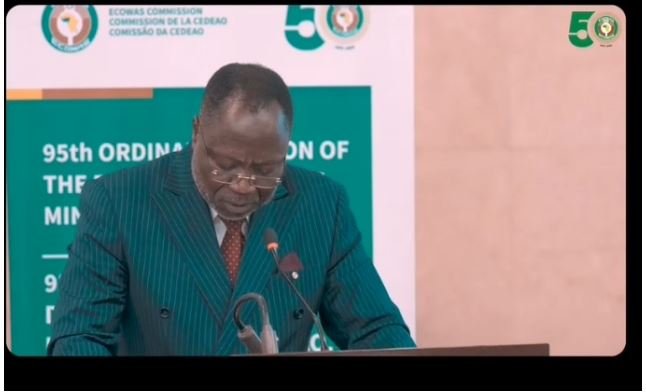
Dr Touray stated this at the Ninety-fifth Ordinary Session of the ECOWAS Council of Ministers held in Abuja 9th -10th December. Proposal has been received from the Republic of Sierra Leone for organisation of a West Africa Economic Investment Summit.
He noted that, this appetite for intra-regional investment underscores the need to mobilise capital within the region, in order to build the Community rather than wait for what he described as precarious foreign investments.
He informed the Council that they have identified Alhaji Aliko Dangote to be the Pioneer Chairperson of the ECOWAS Business Council, in view of his vast experience doing business within the sub-region, and across Africa.
Dr Touray noted that through the Council, they hope to bring the private sector actors around the table as they discuss economic integration and development of the region.
“In this regard, the Business Council will facilitate dialogue and partnership between the private sector, governments, and ECOWAS institutions. At this ordinary Session of Council, you will be examining various memoranda requiring your decision and noting for information.
“We will be presenting, for your decision, the annual work programme and budget of the Community institutions, the financial situation of the Community, the status of implementation of the Community levy protocol, as well as, reports of the Auditor General of ECOWAS Institutions, and the Audit Committee.
“With regard to our integration programme, we will be presenting memoranda on regional resilience, monetary integration, resource mobilization for the activation of the regional force for countering terrorism, as well as, the resolution of the Board of the ECOWAS Bank for Investment and Development, among others.
“Furthermore, we will be presenting for information memoranda on the status of implementation of the ECOWAS Trade Liberalisation Scheme, including the work of the Task Force on the ETLS, as well as the Memorandum on the ECOWAS single currency programme.
“Council will also be briefed on the financial situation of the West African Power Pool, our flagship regional electricity market platform that is currently facing challenges on account of debts owed by national electricity companies. We count on member states to help with the recovery of the debts owed to the Power Pool”, Dr Touray said.
He added that they hope that the deliberations on the various items on the agenda will pave the way for a region that is self-sufficient, free from external control and vulnerability to external economic shocks.
On his part, the Chair of the ECOWAS Council of Ministers, Alhaji Musa Kabba, said the meeting reaffirms their steadfast dedication to regional cooperation, guided by their collective vision of an integrated and prosperous West Africa.
He reiterated their recognition of the vital responsibilities entrusted to them, and the collaborative effort required to attain substantial
outcomes for the community.
“It is therefore imperative that we thoroughly consider the Commission’s recommendations and collaborate effectively to realize this vision. We must persist in our efforts to foster an environment conducive to the growth of the private sector, the principal catalyst of the economic integration agenda.
“While it is acknowledged that integration may sometimes evoke complex sovereignty issues,
it is ultimately advantageous for all member states.
Furthermore, it is imperative that we demonstrate a robust commitment to the promotion and enhancement of trade within the subregion.
“The current perspective of intra-regional trade line lies behind that of all regions. To address this disparity, we should utilize existing mechanisms to foster greater regional economic collaboration, such as equalization in the ECOS investment code, improve transport and energy connectivity,, and promote digital transformation as a catalyst for innovation”, he said.
He stressed the need towards addressing non-target barriers, modernize and operationalize borders, and improve the joint modernization process, noting that they must also prepare the region to fully capitalize
on the opportunities presented by the African Continental Free Trade Area, which directly advances the internal integration agenda.
“My country, Sierra Leone, remains committed to this initiative. Today, ECOWAS finds itself at a pivotal juncture. The region is confronting intricate challenges, including unconstitutional alterations of government, security threats, terrorism, violence, extremism, transitional, national organized crime, indecisive trafficking, and recurring communal conflicts.
“The crisis on the side remains profoundly severe, despite the courage and sacrifices of our security forces. Terrorist organizations assist in destabilizing communities, undermining state authority, and impeding development.
“It is self-evident that no single nation can control these challenges independently.
They can only be resolved through enhanced cooperation and mutual understanding among our member states. Also, we must assist in investing in peace and security initiatives for the sectoral and border operations, border protection cooperation, and mediation efforts, activate the ECOWAS Standby Force, and provide support to member states’ basic training.
“In addition, it is essential to ensure that diligent diplomacy, strategic leadership, political gathering, military cooperation, and development assistance are integrated effectively to address the root causes and foster long-term, resilient and sustainable unity”, he said.
According to him, the return of the constitutional change of government continues to represent one of the region’s most great challenges, stressing that their regional alliance was established on the fundamental basis that democracy is essential for peace, stability, and prosperity.
“Our community must uphold and contribute zero tolerance laws to military rules, or any breaches of constitutional governance. Constantly, we all must condemn the resurgence of coolers in our region in all their forms and manifestations. A surge of constitutional regime changes impede national development.
Meanwhile, the Minister of State for Foreign Affairs, Amb. Bianca Odumegwu-Ojukwu, said their accomplishments stand as a powerful testament to the vision of our founders who understood
that West Africa’s greatest strength is forged through unity, solidarity, and collective progress.
“We are inspired to reach a new high. Nurturing a region and providing peace, prosperity, and limitless possibilities for generations to come. Yet, even as we celebrate these milestones, we must confront stark realities facing our region.
“Recent years have witnessed political instability and lack of inclusivity. They undermine the systems of confidence and weaken the regional cooperation that has defined efforts to have a center. We must therefore remain steadfast by promoting inclusive political dialogue, and supporting technical transitions that reinforce stability.
“Our unity and collective resolve are essential to navigating these periods of uncertainty.
At the heart of ECOWAS lies the aspiration of the European Union, for the community’s integration
that delivers tangible benefits for our community citizens. It is this ideal of shared markets, interconnected infrastructure, increased mobility, and coordinated development that has inspired our founding founders to establish the region.
She emphasised that the region’s future depends on deepening interregional strength, strengthening value chains, facilitating investments, and creating opportunities for the over 400 million people, especially people of 25 years and below, who constitute about 65% of the population.
“They no doubt rely on ECOWAS to chart the path towards progress”, she said.
She urged the Ministers who are entrusted with steering, the Committee ‘s course, noting that their insights and decisions will be instrumental in shaming the recommendations to be submitted to the authority of heads of state of government.
“The dossiers before you speak to crucial issues of governance, economic integration, humanitarian
response, peace and security, agriculture, and institutional effectiveness, she said.
The meeting featured indepth deliberations, and adoption of workable recommendations.