
World Leaders Take Sides On US/Israeli Strikes In Iran.
By Ferdinand Olise
The U.S. and Israel attacked Iran on Saturday that killed Supreme Leader Ayatollah Ali Khamenei, in what President Donald Trump said was a massive operation to destroy the country’s military capabilities and eliminate the threat of it creating a nuclear weapon. He urged Iranians to “take over your government.”
Iran launched counterattacks, firing drones and missiles at Israel and strikes aimed at U.S. military installations in Bahrain, Kuwait and Qatar. The exchanges of fire continued into the night. Iranian state media, citing the Red Crescent, said on Saturday evening that at least 201 people had been killed and more than 700 injured.
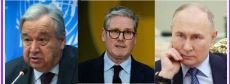
In the hours after the initial U.S. and Israeli strikes, Russia and China released statements in support of Iran, while Canada, Australia and Ukraine were among those who expressed support for the U.S. and Israel. Several world leaders urged restraint and de-escalation on both sides moving forward.
According to Spokesperson of China’s Ministry of Foreign Affairs, in a message reposted by the Chinese Embassy in Nigeria on their verified X-handle on Sunday, March 1, “The attack and killing of Iran’s supreme leader is a grave violation of Iran’s sovereignty and security. It tramples on the purposes and principles of the UN Charter and basic norms in international relations. China firmly opposes and strongly condemns it”.
“We urge for an immediate stop to the military operations, no further escalation of the tense situation and joint effort to maintain peace and stability in the Middle east and the world at large”
The UK government on Saturday said in a statement it “does not want to see further escalation into a wider regional conflict.” Still, a government spokesperson emphasised that “Iran must never be allowed to develop a nuclear weapon and that is why we have continually supported efforts to reach a negotiated solution.”
Starmer released a joint statement with French President Emmanuel Macron and German Chancellor Friedrich Merz, telling Iran to stop their retaliatory attacks on countries in the Middle East.
“We condemn Iranian attacks on countries in the region in the strongest terms,” the joint statement reads. “We call for a resumption of negotiations and urge the Iranian leadership to seek a negotiated solution. Ultimately, the Iranian people must be allowed to determine their future.”
UN Secretary General, Antonio Guterres, condemned the military escalation, and warned that international peace and security were being undermined.
“The use of force by the United States and Israel against Iran, and the subsequent retaliation by Iran across the region, undermine international peace and security,” he said in a statement.
“I call for an immediate cessation of hostilities and de-escalation. Failing to do so risks a wider regional conflict with grave consequences for civilians and regional stability.”
Italian Prime Minister Giorgia Meloni’s office said it would be consulting allies and regional leaders to support efforts to ease tensions.
In a statement, Brazil’s government condemned the US and Israeli attacks and expressed “grave concern”.
Australian Prime Minister Anthony Albanese said his country backed the US “acting to prevent Iran from obtaining a nuclear weapon and to prevent Iran continuing to threaten international peace and security”.
Perhaps cautious about upsetting already strained relations with U.S. President Donald Trump, many nations abstained from commenting directly or pointedly on the joint strikes but condemned Tehran’s retaliation. Similarly to Europeans, governments across the Middle East condemned Iran’s strikes on Arab neighbors while staying silent on the U.S. military action.