
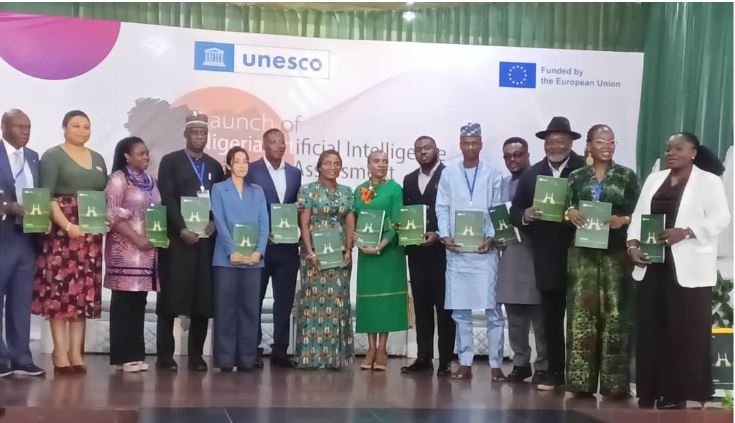
UNESCO, EU, Launch RAM Report In Nigeria, Boost AI Readiness.
By Ferdinand Olise
The United Nations Educational, Scientific and Cultural Organization, UNESCO, and the European Union, EU, through their partnership and collaboration have created a roadmap towards harnessing the opportunities that Artificial Intelligence (AI) provides, and addressing the challenges it portends.
UNESCO and the EU launched the Nigeria Artificial Intelligence Research Assessment Methodology (RAM) Report which provides a comprehensive assessment of Nigeria’s preparedness to harness the opportunities presented by Artificial Intelligence, while promoting its ethical, inclusive, and responsible development in line with UNESCO’s recommendation on the Ethics of Artificial Intelligence.
UNESCO and EU reaffirmed their commitments to supporting Nigeria’s quest to become a leader in ethical and inclusive Artificial Intelligence development with the launch of the Nigeria Artificial Intelligence RAM Report.
In his welcome remarks, the Officer-in-Charge of the UNESCO Abuja Office, Mr. Dimitri Sanga, who was represented at the occasion by the Head of Finance and Administration, UNESCO, Fatu Comfort-Sumo, said in November 2021, UNESCO’s 193 Member States unanimously adopted the historic Recommendation on the Ethics of Artificial Intelligence which serves as the first global, standard-setting normative framework designed to ensure AI technologies are developed and deployed in a human-centric, rights-based, and sustainable manner.
“From protecting human rights, promoting fairness, preventing biases and harm, the recommendation sought to unify global action towards an AI ecosystem that benefits everyone. In addition, UNESCO with funding from the European Union, have since 2024, been supporting Nigeria through RAM, to operationalize digital infrastructures, policies and institutions, across five key dimensions.
“We must not forget that diagnostic report is not a destination. This is the beginning of informed decision making. A reminder of what we can do through national strategy, governance framework, research, innovation and education for a human-centric AI.
“On our part, we have commenced the capacity building component, having leveraged EU support to train over 400 civil servants across six states in Nigeria using AI Literacy Training Module.
Going forwards, we are open to partner with more States, MDAs and every stakeholder present today to enhance human capacities and provide the needed guardrails for everyday interaction with AI system.
“Commendably, Nigeria has demonstrated outstanding leadership on integrating UNESCO’s recommendation on the Ethics of AI in its national strategy”.
“With the responsive backing of relevant MDAs, I am confident that this report will be effectively deployed to reaffirm Nigeria leadership role in leveraging Ethical AI for development in Africa”, he said.
Also, the Delegation of the European Union to the Federal Republic of Nigeria and ECOWAS: Ms. Ikram Tolba, emphasised European Union’s commitment to partnerships in ensuring AI ethics and standards. She said the assessment showed that Nigeria already possesses many of the ingredients required to become a major AI player.
She expressed EU’s commitment to supporting Nigeria through research partnerships, AI standards development, advanced computing infrastructure and digital investment programmes.
According to her, in 2025 they reached their goal of mobilising €860 million for digital infrastructure, identity, public services and skills development, noting that Nigeria possesses sovereign ambition, institutional capacity and market scale. He added that the partnership would be meaningful for both sides.
Meanwhile, the Minister of Communications, Innovation and Digital Economy, Dr Bosun Tijani,
who was represented by the National Director of the National Centre for Artificial Intelligence and Robotics, Dr Bunmi Ajala, described the report as a critical tool for measuring Nigeria’s progress and identifying areas requiring further investment.
The Report was developed through the collective efforts of key institutions and stakeholders across government, academia, private sector, and Civil Society. The occasion was graced by stakeholders from strategic sectors who made tangible impacts towards achieving AI globally accepted ethical standards.