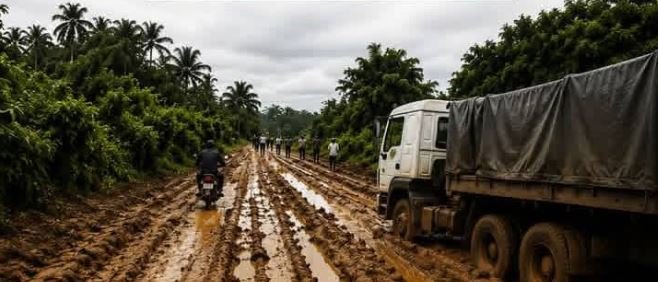
Ikare–Ogbagi–Irun–Imesi Ekiti Road: A Death Trap Built By Neglect And Sustained By Political Silence.
By Owolola Adebola
There are moments when silence becomes complicity.
There are situations in which looking away is no longer neutrality but a tacit acceptance of suffering. And there are public infrastructure failures so grave that every responsible government, politician and representative should be embarrassed by the mere fact that, they have been allowed to persist.
The deplorable condition of the Ikare–Ogbagi–Irun–Imesi Ekiti road has reached that point.
This is no longer simply a bad road.
It is a death trap.
It is an economic obstacle.
It is an assault on the dignity of the people who use it every day.
It is a road that has become synonymous with fear, broken vehicles, delayed journeys, business losses and avoidable human suffering.
And perhaps most infuriatingly, it is a road whose condition is not unknown to those who have the political authority and influence to demand urgent intervention.
They know.
They have seen it.
They have heard the complaints.
They have been told about the suffering.
They know that the road connects important communities across Ondo and Ekiti States.
Yet, somehow, the political establishment has perfected the art of looking the other way.
How convenient!
A Road to Nowhere—or a Government Going Nowhere?
What exactly does government mean when it talks endlessly about development?
Is development the construction of impressive buildings in urban centres while rural communities are left to navigate roads that resemble abandoned mining sites?
Is development about political slogans, ribbon-cutting ceremonies and glossy photographs while citizens risk their lives travelling between neighbouring communities?
Is development about telling people that government is working while a major economic corridor continues to collapse beneath their tyres?
The people deserve answers.
The Ikare–Ogbagi–Irun–Imesi Ekiti road is not a private driveway belonging to a handful of citizens. It is a public road serving communities whose residents are entitled to safe and functional infrastructure.
Yet the condition of the road increasingly suggests that its users have been abandoned to their fate.
One wonders what would happen if the road were located in the immediate neighbourhood of a powerful politician.
Would the potholes remain for years?
Would the road be allowed to deteriorate to this extent?
Would motorists continue to destroy their vehicles?
Would families continue to mourn?
Or would emergency intervention suddenly become possible?
That is the uncomfortable question politicians must answer.
When Potholes Become Graves
A pothole is not always just a pothole.
On a dangerous road, a pothole can become an ambush.
A motorist attempting to avoid one can collide with another vehicle. A driver travelling at night may not see the crater until it is too late. A motorcycle rider can lose control. A commercial vehicle can suffer mechanical failure in an isolated section. A heavily loaded vehicle can overturn.
The consequences are sometimes irreversible.
A family loses a father.
Children lose a mother.
A community loses a productive young man.
A business loses its operator.
And government issues another statement of condolence.
That cycle must stop.
It is morally indefensible for authorities to wait until citizens die before they begin discussing the road.
Prevention is also governance.
A responsible government does not merely respond to tragedy. It identifies dangerous infrastructure and acts before tragedy occurs.
The Road Is Also Killing Businesses
The victims of this road are not only those who die in accidents.
Businesses are dying quietly.
Transport operators are paying heavily for vehicle repairs. Tyres, shock absorbers, springs and other components are damaged with alarming frequency. Journey times are unnecessarily prolonged. Transportation costs rise.
And when transportation costs rise, the consumer eventually pays.
Farmers are particularly vulnerable.
What is the value of producing agricultural commodities if getting them to market becomes a nightmare?
A farmer can cultivate his cassava, yam, maize, cocoa or other produce, only to discover that moving it to the market consumes a disproportionate part of the expected profit.
Perishable goods face an even greater threat.
By the time produce reaches its destination, part of it may have deteriorated.
This is how bad roads become instruments of economic sabotage.
Not because anyone deliberately designed them to destroy the economy, but because prolonged infrastructural neglect produces precisely that effect.
Where Are the Political Champions?
This is where the political dimension of the matter becomes unavoidable.
Where are the people who speak loudly when elections are approaching?
Where are those who know how to mobilise crowds, distribute campaign materials and make promises from podiums?
Where are the elected representatives who regularly tell their constituents that they are their voice in government?
Where is that voice now?
The people do not need another political speech.
They need someone to carry their case to Abuja, Akure and Ado-Ekiti with the urgency it deserves.
They need representatives who will refuse to accept bureaucratic excuses.
They need political leaders who will ask uncomfortable questions in government offices.
They need people who will insist that the road be inspected, evaluated, budgeted for and rehabilitated.
Influence is meaningless if it cannot be used when the people are suffering.
A political office is not a trophy.
A political appointment is not a personal reward.
An elected position is not a permanent invitation to ceremonies.
These positions exist because citizens entrusted individuals with responsibility.
The real test of leadership is not how politicians behave when cameras are present. It is what they do when ordinary people are crying for help.
Stop Using the People Only During Elections
One disturbing feature of Nigerian politics is the tendency to remember neglected communities when votes are needed.
Suddenly, politicians discover the roads.
Suddenly, they discover the farmers.
Suddenly, they discover the traders.
Suddenly, every village becomes important.
Promises are made.
Hands are shaken.
Photographs are taken.
Campaign vehicles disappear.
Then the people are left with the same potholes.
The same darkness.
The same unemployment.
The same poverty.
The same broken infrastructure.
The same political silence.
This must not continue.
The people of Ikare, Ogbagi, Irun and Imesi Ekiti are not electoral statistics.
They are citizens.
They deserve infrastructure that reflects their humanity and contribution to society.
A Road That Could Transform the Region
The tragedy is that the road has enormous economic potential.
A properly rehabilitated Ikare–Ogbagi–Irun–Imesi Ekiti corridor could become an important link for commerce and movement between communities.
It could facilitate agricultural trade.
It could reduce transportation costs.
It could encourage small and medium-sized enterprises.
It could improve access to schools and healthcare.
It could increase the mobility of workers.
It could make communities along the route more attractive to investors.
In other words, fixing the road is not merely about filling potholes.
It is an investment in people and the regional economy.
Government should therefore stop treating the road as a nuisance that can be postponed indefinitely.
It should be treated as a development priority.
No More Cosmetic Repairs
What the road needs is not another hurried exercise in political theatre.
The people have seen enough of temporary solutions.
A few trucks arrive.
Some materials are deposited.
A few potholes are filled.
Photographs are taken.
Officials declare progress.
Then the rains come.
And the road returns to its previous condition—or becomes worse.
That is not development.
It is an expensive cycle of pretence.
What is required is a proper engineering assessment and durable rehabilitation or reconstruction, supported by effective drainage, adequate road shoulders and proper maintenance.
The responsible authorities must tell the public what has been done, what is being planned and when tangible work will commence.
The people have a right to know.
The Silence Must End.
Perhaps the most painful part of this entire saga is the silence.
Silence from people who should be speaking.
Silence from those who should be lobbying.
Silence from those whose political influence could make a difference.
Silence while citizens struggle.
Silence while businesses suffer.
Silence while vehicles are destroyed.
Silence while the spectre of avoidable accidents hangs over the road.
But there comes a point when silence becomes indefensible.
This is that point.
Those in positions of influence must be challenged to explain their inaction.
If they have raised the matter, let them tell the public what response they received.
If they have secured intervention, let them tell the people when the work will begin.
If funds have been appropriated, let the public know.
If bureaucratic obstacles exist, let them be exposed.
If there are jurisdictional disagreements between levels of government, let those disagreements not become excuses for abandoning citizens.
The people are not interested in who owns the road. They want to know who will fix it.
A Final Warning
The Ikare–Ogbagi–Irun–Imesi Ekiti road cannot continue to be treated as an afterthought.
Every day of delay carries a cost.
Every journey carries a risk.
Every damaged vehicle represents a financial burden.
Every lost business opportunity represents economic stagnation.
And every fatal accident leaves a scar that no government condolence message can erase.
Those in authority must understand something fundamental: government is not judged only by the projects it commissions. It is also judged by the suffering it allows to continue.
History will not ask only who occupied offices.
It will ask what they did with those offices.
It will ask who spoke when the people were suffering.
It will ask who acted.
And, painfully, it may also ask who knew but looked away.
The Ikare–Ogbagi–Irun–Imesi Ekiti road is crying for attention.
The people are crying for help.
The economy is crying for relief.
Must another family bury a loved one before government finally listens?
Must another transporter lose his livelihood?
Must another farmer watch his produce rot because of an impassable road?
Must another vehicle be destroyed?
Must the people continue to travel this death trap with prayers on their lips and fear in their hearts?
Enough is enough.
Those who have the power to act must act now.
Those who have political influence must deploy it.
Those who represent the people must represent them.
And those who have remained silent must understand that leadership without action is nothing more than an empty title.
Fix the road before the road claims another life.
Fix the road before another business collapses.
Fix the road before another generation is condemned to underdevelopment.
The people of Ikare, Ogbagi, Irun and Imesi Ekiti are asking for no favour.
They are asking for what is rightfully theirs:
A road that connects, rather than a road that kills.