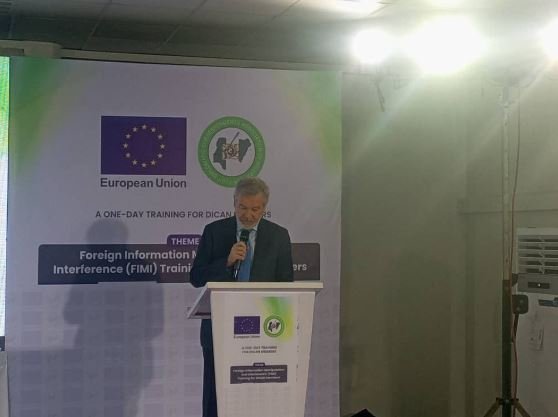
EU Promotes Media Literacy, Fact-checking To Combat Dangers of False Information Threatening Nations Democracy.
By Ferdinand Olise
The European Union Ambassador to Nigeria and ECOWAS, Gautier Mignot, has harped on the dangers of false information put out in any guise, and for whatever motive, which he says harms the society as it compromises the integrity of the media, undermines trust in public institutions, and weakens people’s capacity to take informed decisions on issues that affect them.
Speaking in Abuja on Monday, at a one-day workshop on Foreign Information Manipulation, organised for Members of the Diplomatic Correspondents Association of Nigeria, Ambassador Mignot warned that the consequences of false information become more dire when misleading information is deliberately crafted with an intent to deceive, and pushed into the public space to unsuspecting helpless citizenry.
“The media is one of the pillars of a free, democratic society. When people lose faith in such critical institution, democracy is at risk, and the society itself is gravely endangered.
For media professionals, the implications are far reaching because whatever reduces the credibility of the message also erodes the integrity and moral authority of the messenger – and his platform. And in a sense, this is also true for diplomats: if we want to remain credible and reliable, we have to make sure that the information we spread is accurate. This is why the subject of this workshop, Foreign Information Manipulation and Interference (FIMI), is an important one.
“Journalists are multipliers in the information value-chain: they control what passes through the media channels into the public space. It is not surprising, therefore, that they can also be frontline targets of FIMI. And this is for a good reason: once the media is misinformed, or dis-informed, the entire society is at risk of being deceived. Now, technologies have made communication easier and faster. But their uncanny ability to falsify or even recreate realities has also enhanced the ease and rapidity of producing and spreading deceptive content, both online and offline, which are more and more difficult to distinguish from original contents.
“So it’s not a surprise that, according to a July 2024 report published by the European Parliament, many people across the world today worry about the effect of misleading information: Some 85 % of people worldwide are concerned about the impact of disinformation on their fellow citizens; 87 % think disinformation has already affected political life in their country; and 38 % of EU citizens list false and/or misleading information as a threat to democracy”, he said.
He further said that in a 2020 report on Nigeria’s Disinformation Landscape, the Centre for Democracy and Development, (CDD), warned that the volume of disinformation now circulating in Nigeria is unprecedented, and has further exacerbated pre-existing ethnic and religious tensions that predate the internet.
He said, “The report pointed to what it described as Nigeria’s “big, strong, unimaginatively creative, but invisible rumour mill” and pointed out that both falsehoods and accurate information could now spread faster and in a multitude of formats, including text, audio, images, memes, and videos, all thanks to technology.
“In a sense, this could as well be good news for traditional professional media: while some were and sometimes still are predicting the end of traditional media and their replacement by millions of individuals producing and commenting news, the role of professional media is again legitimised by their reliability compared with the informative chaos on the social networks.
“But for this to happen, there are two conditions. First, media must remain reliable, they must be fact-checkers and make sure in particular that the research for the scoop does not beat the research for the truth. And, second, the public must be aware of the danger of false information and willing to escape from it and not prefer pleasant lies to unpleasant truth”.
Ambassador Mignot therefore said that while disinformation campaigns may start on social media platforms, they also penetrate offline spaces, influencing the contents of conventional media, and shaping the well-established word-of-mouth rumour mill.
The Ambassador expressed displeasure that the situation is becoming increasingly difficult to draw a distinct line between content that is shared on social media, and information reported, or broadcast by Print media, Radio, and Television. He stressed that this un-discernible diffusion of social media content into the traditional channels, has created problem around transparency and accountability, which are key features underlining media credibility.
“In such a dire situation, media and information literacy, both within and outside the Fourth Estate, has become an urgent compulsion rather than a choice. A literate public is much more empowered to be able to assess the information they are exposed to, identify sources they can trust, and make well-informed decisions, participate in debates and shape policies that affect them.
“Information manipulation and disinformation erode democratic values; breed mutual suspicion and disaffection; and undermine peace, security and stability at both national and regional levels. The growing glamorisation of anti-democratic forces as superheroes, in opposition to democratic values, is a sad pointer to the damage information manipulation is causing in West Africa. Again, Nigeria is by no means exempt from this phenomenon”.
“Well organised campaigns pretending for instance to oppose the starling successes of young leaders of AES countries -even if they are nothing but a mirage- to what they present as a failure of Nigeria’s democratic government are just one example of this.
Speaking about the dangers posed by disinformation, and the need to combat it, Ambassador Mignot, said the European Union is actively working to promote media literacy, with fact-checking playing a crucial role in these efforts. He noted that, within its borders, the EU has adopted far-reaching measures to combat disinformation, and that Internationally, the EU is working with partners, including the media, and the civil society to protect the integrity of the information matrix, Nigeria inclusive.
“As part of a comprehensive response, the European Union works to support actions that guarantee media freedom and pluralism, and ensure that citizens have access to quality news and information they can trust. Cooperation, awareness-raising, and support for fact-checking, and media literacy initiatives are key aspects of our response to the challenge of disinformation, which is multi-faceted”, he said
According to him, the EU monitor and analyse disinformation campaigns, particularly those targeting elections, or sensitive topics, noting that this is one of the features of the electoral support they provide through their SDGN project, in support to democratic governance in Nigeria.
‘We promote media literacy initiatives and provide resources for citizens to critically evaluate information. Earlier this year, we facilitated a fact-checking training for Members of the Nigerian Guild of Editors in Lagos.
We support fact-checkers and researchers working to debunk disinformation and foster collaboration among them. Our previous work with Nigeria’s foremost fact-checking platform, Dubawa, is an example.
“We are also building up critical capacity for fact checking in the media, and to help journalists strengthen their resilience to disinformation, information manipulation and propaganda. Besides the support we offer locally through our media-focussed interventions, we also directly facilitate the participation of Nigerian journalists in trainings on media literacy in Europe.
He said that in this regard, they actively cooperate with other institutions, Civil Society Organizations, and online platforms in their efforts to counter disinformation, and promote media literacy.
He said the aim of the training is to enable the field reporters, who are first-line purveyors of public information, with a considerable weight of responsibility to their media organisations, and the larger society.
Also, as Diplomatic and Foreign Affairs Correspondents, who stand at the intersecting point between the country and the outside world in terms of how information of foreign origin, or foreign orientation are filtered into society.
He further said this is to assist the Journalists reporting the activities of the EU and its Member States.
He said the Journalists have proved strong interest and commitment to fighting Foreign Information Manipulation and Interference, FIMI, adding that the workshop will add value to them in the discharge of their critical responsibility to the society and the world at large.
Speaking to the Journalists on FIMI foundations and Concepts, as well as strategic counter-measures, the 2019/2020 African Liberty Writing Fellow, Mr Ekeoma Precious Ohaegbulam, urged the Journalists to always localise foreign concepts when adapting them in order to know where and how it applies to local context.
It’s called policy diffusion, policy adaptation, how you can take a policy that works in a city, in a few, for example, but if you localise it to Nigeria, it might fail because of certain contextual limitations.
“You come together to define and put a framework in place to say before we even start categorising something as fake news, or alternative facts, or misinformation, or disinformation, can we have a framework to say, what is this thing? You know, it’s one thing for your child to lie and know that, that lie is a mistake. It’s another thing entirely for your child to know before lying to you that this thing I want to say is a lie. That’s a different thing entirely”.
“If you don’t know how your enemy works, how can you even understand how to fight them?
So, the EU has come together to say, this framework we are putting in place, we want to help Fact-checkers, Researchers, newsroom executives, Reporters, Correspondents”, he said.
On his part, the Nigeria Editor, Africa Check, Mr David Ajikobi, described disinformation as a cancer.
“It’s important for us to be told about what disinformation is in the traditional sense. Every disinformation is a disease. It’s like a cancer. There are different kinds of cancer, disinformation also has different types, and sometimes we cannot have a targeted approach to solving, or to countering if we don’t understand where it is coming from, or the types”, he said.
Also, the Press and Information Officer, EU Delegation to Nigeria, Mr Modestus Chukwulaka, who anchored the workshop, expressed his gratitude to the European Union, and appreciated the resource persons, and the Journalists.
He said the integrity of the information in public space is something that is very, very good to the heart of the EU, noting that, if people are better informed, they are better human beings, they take better decisions, and the society is better for it.
“So, we are all stakeholders in this. Whether we are in the media, we are not in the media, whatever we do affects every person. So let us understand the responsibility we have towards our media organizations, and towards the society”, he said.