Group Against Gender Based Violence Calls For Better Ways To Cater For Girls, Children, Vulnerable Groups.
By Ferdinand Olise
The Plan International Nigeria, has called for action against every form of violence against persons, both in Nigeria and across the world.
This is as part of activities marking the sixteen (16) Days of Activism towards ending Gender Based Violence, (GBV), and other related vices.
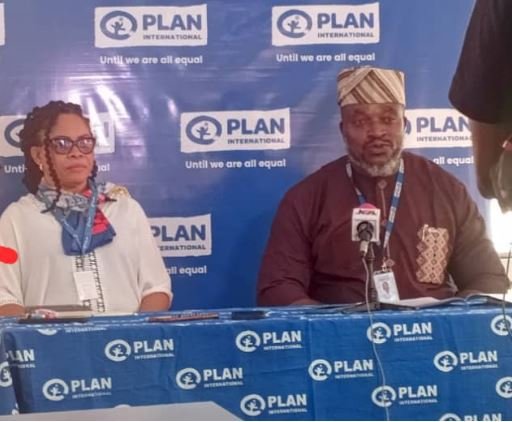
Speaking in Abuja at a Press Conference which forms part of the activities to commemorate the 16 Days of Activism against Gender-Based Violence, the Country Director Plan International Nigeria, Mr Charles Emmamuzou Usie, said their mandate globally and in Nigeria which is to seek for the rights of children and equality for girls, clearly falls within the mandate of the 16 days of activism set up many years ago by a group of partners and governments.
He therefore expressed their areas of interest on what the Plan International aims to achieve in commemorating these 16 Days of Activism which he said include to prioritise protection of the dignity of every human being, particularly children and girls, which falls within their mandate.
“And this year, we are looking at how we can strengthen the protection mechanisms, particularly through digital platforms. There is increasing levels of violence, harassment, intimidation, which is targeted at girls especially, using very, you know, many digital means. And for us, this year, as we mark this season of activism, we want to call for every well-being manager”.
“We want to call on the government, civil society, and every actor who have the interest of children and girls in the country to actually create some form of visibility, to improve the knowledge and awareness of what is happening online through our digital platforms, and to use every means possible to discourage and stop it permanently, so that when we gather next year, we will not be talking about the same issues”, he said.
The conference also provided a platform for presentation of key findings from the Plan International’s State of the World’s Girls report.
“In Nigeria, girls have come under attack, serious attack, digitally. And they’ve been exposed, they’ve been abused, simply because digital platforms are free and available for everyone. Now, when we have advancement in forms of digital advancement, like we have in Nigeria and across the world, it is meant for human advancement.
“It is meant for the betterment of lives, it is meant to improve our collective well-being. However, some group of unscrupulous people have decided to use it as a means and as a target for girls who they see or think are vulnerable. Today, our statement is that girls are not vulnerable, girls are not victims. And today, as Planned Nation, I will stand with girls to say that we refuse to allow further intimidation, deprivation, targeting of girls through any digital platform. And that is our stand and that is our vision for what we celebrate today for the 16 days of activism as Planned Nation.
“In addition to that, we have a few points we want to reiterate as we celebrate the 16 days of activism.
And the first one is that no more excuses for not fixing what needs to be done. We need to think of the practical policies and systems we need to set up to protect girls, particularly from forced unions and any marriages in any form.
“To this extent, we are calling on the National Assembly and the Government of Nigeria to agree on a defined age of consent for marriage for girls. Decided by girls, for girls. This is a mandate we think that the Federal Government of Nigeria has come of age to make this decision. We still have an increasing number of girls who are married off way below 13 years, some at 13, some at 15.
“Still at the prime of their teenage years. And they are forced to become mothers and take on responsibilities that are beyond their capacity. Denying them their childhood, denying them the opportunity to live as girls and to live as young persons.
“We think this is a disgrace, this is an outrage. Today, we call on the Government, and every well-being in Nigeria to ensure that we expose this scandal of forced union and any marriages for girls in Nigeria.
And call on the Nigerian Parliament to have a conversation, a public hearing, and a process that will lead us to instituting a decent age for consent for marriage for girls in Nigeria”.
“This is one of the biggest celebrations we should come out from this 16 days of activism if it comes to life through the Nigerian Parliament. In addition, we have an increasing number of girls who are still dropping out of schools, and it is coincidental that today as we mark this 16 days of activism, just a few days ago Nigeria has been riddled with several levels of kidnapping, and abduction of children in schools, particularly girls. We have seen in recent times in Nigeria that girls have become easy targets for political gains.
Girls have become targets for terrorism. Girls have become targets for violence, because they know that kidnapping girls and attacking girls in school is an easy soft-target that whips up sentiment, and that causes great distress to both families and to the nation”.
Today, Plan International is in solidarity with all girls in Nigeria. It is calling for the government to step up its action to protect girls in schools, and we can do that in very many ways. One is to at least meet the minimum standards for the safe school declaration mandates that Nigeria already a signatory to. There are five provisions that should make schools safe anywhere in Nigeria. Nigeria needs to review those minimum provisions and ensure that schools become safe for both children and girls especially.
Mr Usie also underscored the importance of enrolling girls in school,as well as for them to remain in school and graduate with good learning outcomes that can give them the possibility of a bright future.
“This is within our means as a nation. This is within the circle of influence of government and credible partners and well-meaning Nigerians. Today, we are calling on all of the stakeholders to ensure that schools remain a place of refuge, solace, learning, formation for girls and for children, and not a place of fear anymore. We also call on the government, partners, families, well-meaning Nigerians to continue to expand the frontiers for girls to gain meaningful jobs, employment and income.
“Financial accessibility, financial income and stability is one of the biggest forms of empowerment for girls, especially in this part of the world, in Nigeria. There are many girls who are growing into poverty for no fault of theirs and many girls who are willing to work and end their living so that they can decide and make decisions about their future where they are incapacitated and have no access to commercial resources.
As we continue with the 16 days of activism, we will continue to work with the government to ensure that schools remain a place of refuge, solace, learning, formation for girls and for children.
“One of the things that should keep burning in our minds is to continue to reflect what ways can we expand the financial prosperity for girls, to give them access to loans, access to businesses, access to decent employment, to enable them to live decent lives that will be their lifeline. And then, we are also calling on the government at this point in time, and particularly our traditional and religious institutions, to review cultural, cultural and religious practices that are important for girls.
So, we have to draw on the Insure Design of traditional practices that actually domesticate girls and stop them from achieving their full potentials. Across many Nigerian communities, we have a lot of girls who suffer indiscriminately simply because they are girls, for the traditional and harmful practices that limit their opportunities to gain meaningful employment, to gain relevant knowledge, and to seek better opportunities as they so desire.
“They are held back by traditional practices and systems that have no meaningful or tangible impact and benefits to girls. Today, as we celebrate, we are calling on every well-meaning Nigerian to lend their voices to girls, and to see within their community communities what laws and systems, traditionally, religiously, culturally, that hold girls back from achieving their full potentials.
“Within these 16 days of activism, we are calling on every well-meaning Nigerian to join their voices,
bring their energy together, and see how we challenge those practices and reduce their impact on girls.
And finally, we are calling on the mobilization for more resources to be allocated to girls’ welfare.
We commend some State governments, and the federal government for every investment they’ve made
in ensuring that our systems, our policies, and the budgets we have in this country work for girls.
“We commend the federal government of Nigeria, particularly its administration, for ensuring that girls continue to enjoy the loans to continue their schools, particularly in higher education.
That has ensured that many girls continue to go to school, remain in university and graduate,
without suffering any financial burden, but we think that is not enough, and we can do more.
“There are many other places, other systems, other sectors, that girls need this kind of support, and girls need to thrive by the policies and systems that we have set up for us as a country of our nation, and this includes issues concerning even their reproductive health, issues related to basic welfare of sanitation, water, and hygiene”.
“All of these contribute to the welfare and to the experience that girls want to have in a country they call their own. I think this is within our limits. This is within the circle of influence for us as a nation to provide for girls. We are calling on governments, we are calling on the private sector, well-being Nigerians, families, to do everything possible to ensure that the systems, and processes that we have set up as a country actually work for girls and work in their favour. These are our requests”, he said
He therefore called on the federal government as the country’s budget for 2026 is being prepared, to ensure that these budgets provide particularly for children and girls, in all their welfare and all they choose to obtain.
On her part, the the Director, Programme Quality and Influencing, Plan International Nigeria, Dr Helen Idiong, said the 16 Days of Activism is a global movement, and that they will work in partnership with other organisations globally, to keep talking about this campaign so that the information will go out, and girls will also understand.
“For us as a child rights organisation, you’re helping us to put this out there. Girls know when they can reach us if they have a problem. They know who they can talk to. If they have an issue online, they know they can reach us for support. So, these are platforms that when girls know where they can get help, it will keep going on after the 16 days of activism. We know that this campaign will keep going on to ensure that girls everywhere in Nigeria, and across the world are cared for”, she said.