Global Rights, EU, Launch Dashboard To Improve Civic Space, Urge Stronger Government, CSO Collaboration.
By Ferdinand Olise
The Global Rights, in partnership with the Community of Practice on Civic Space Strengthening, and the European Union have called for stronger and conducive working environment between Civil Society Organisations and the government in order to create a healthy civic space in the country.
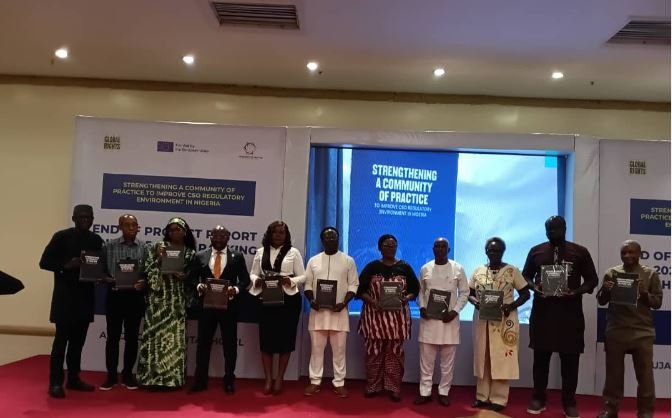
Speaking at the launch of the End-of-Project Evaluation Report and 2025 CSO State Ranking Dashboard Launch under the EU-funded project, with the theme: “Strengthening a Community of Practice to Improve the CSO Regulatory Environment in Nigeria”, held in Abuja, on Monday, the Executive Director, Global Rights, Abiodun Bayewu said Civil society exists because citizens deserve accountability.
She urged Nigerians not to relent in their support civic engagement, noting that criticism of government should not be viewed as hostility.
“Criticism is not an attack; it is part of building a better society. Government and civil society need one another if Nigeria is to progress,” she said.
She encouraged citizens to promote collaboration between government institutions and Civil Society Organisations to deepen democratic governance and improve Nigeria’s regulatory environment.
According to her, one of the project’s major achievements was improving relationships between regulators and civil society, noting that constructive engagement can pave way for public trust.
She further said that a great work has been done in implementing the project in the past three years, requiring collaboration across government and Civil Societies, regulatory agencies, organisations at the Federal, State and Local Government levels, as well as inclusion of women, youth and groups that are often excluded from policy conversations.
On his part, the Head of Cooperation at the European Union, EU, Delegation to Nigeria and ECOWAS, Massimo De Luca, said the launch of the independent end-line evaluation report, which provides an evidence-based assessment of the project’s achievements, lessons learned and recommendations for future programming, and the State Ranking Dashboard, an innovative tool that assesses and compares the regulatory environment for Civil Society Organisations across States, marked an important milestone.
“This dashboard has the potential to encourage constructive dialogue, support informed policymaking and promote positive competition among states to strengthen the enabling environment for civil society.
“The relationships established, the communities of practice nurtured, the knowledge generated and the policy conversations initiated provide a strong foundation for continued collaboration in support of democratic governance and civic participation in Nigeria,” he added.
He said the EU is committed to promoting good governance, democratic institutions and civic participation in Nigeria, and underscored the importance of civil society to democratic governance, its critical roles in citizens representation, advancing human rights, promoting transparency, and contributing to inclusive policymaking.
Luca stressed the need for a conducive regulatory environment that ensures the progress of the civil society to fulfill its roles, adding that the project aims to strengthen regulatory compliance among Civil Society Organisations, encourage dialogue between public institutions and civil society, support
communities of practice across participating States, as well as promote evidence-based regulatory reforms.
The Co-chair of the National Steering Committee of the Community of Practice on Civic Space Strengthening, Ken Henshaw, said the close of project meeting served as an opportunity to evaluate what they have done in the last three years, produce and showcase their report and the dashboard.
This project was conceived three years ago, and we stepped into a very complicated space,
and it’s a space where the civil society is very, very seriously endangered. It’s characterized by the fact that public officials have deliberately restricted the space, ensuring that people can not function, the society cannot function.
“At state, we had regulations that included the fact that Civil Society Organisations have to register at the federal level with CAC, register again at the State level, State Ministries, Parastatals and Agencies, and even at Local Government, they have to all register”, he said.
He said this makes easy for a civil society to be called out as having wronged the process if one single registration was not completed, noting that having so many regulatory frameworks gives the States the opportunities to indict civil society, or infringe on their ability to work.
“Our first point of call was to make the government see that we could actually be partners in the course of progress. We could collaborate. We could do a lot of things together, we made them see that, and showed them the challenges of civil society, how difficult it is to operate in this space. We made them see what civil society was doing in other parts of the world, and basically made a case for them to reduce those regulatory frameworks that affect us.
“Today we assessed three years of outcome, and we’ve seen tremendous progress across the State. I think the most notable is the case of Awa Ibom, where there’s a bill, a law being made currently to make the relationship a lot more easy. We’ve been able to also talk to FIRS, the Corporate Affairs Commission,m, and so on. And they are beginning to better understand the needs of civil society”, he said.
Earlier, Programme Manager at Global Rights, Nora Sedi, said the project had strengthened partnerships among civil society organisations, regulators, legislators and development partners over the past three years. She expressed appreciation to the European Union for supporting the initiative and acknowledged the contributions of members of the Community of Practice, the Corporate Affairs Commission, the Special Control Unit against Money Laundering, the Nigeria Revenue Service and other public institutions.
She added that, sustained dialogue between government and civil society remains essential to strengthening Nigeria’s civic space and promoting an enabling regulatory environment for non-profit organisations.
Global Rights and the European Union therefore called for sustained collaboration between government institutions and Civil Society Organisations to deepen democratic governance and improve Nigeria’s regulatory environment.
According to Global Rights, over the past three years, the project has contributed significantly to strengthening the civic space landscape in Nigeria by building the capacity of Civil Society Organisations, promoting knowledge sharing on regulatory frameworks and global best practices, as well as supporting evidence-based advocacy to improve the enabling environment for CSO operations at both national and sub-national levels. The End of Project Report and 2025 Dashboard Launch provides an opportunity to present the project’s key achievements, lessons learned, impact, key findings, and state rankings, while reflecting on the collective efforts of stakeholders who contributed to advancing civic space in Nigeria.
The programme brought together Civil Society Organisations, regulatory agencies, legislators and policymakers to address regulatory bottlenecks confronting Civil Society Organisations, and recommend implementable means to promote a more enabling civic space.