Health Experts At Best of ASCO Africa 2026 Seek Bridging Of Cancer Treatment Gap.
By Ferdinand Olise
Medical experts from across the globe have convened in Abuja under the Best of American Society of Clinical Oncology, ASCO, Annual Conference, bringing their expertise to bear on the concerted efforts in eliminating the scourge of cancer.
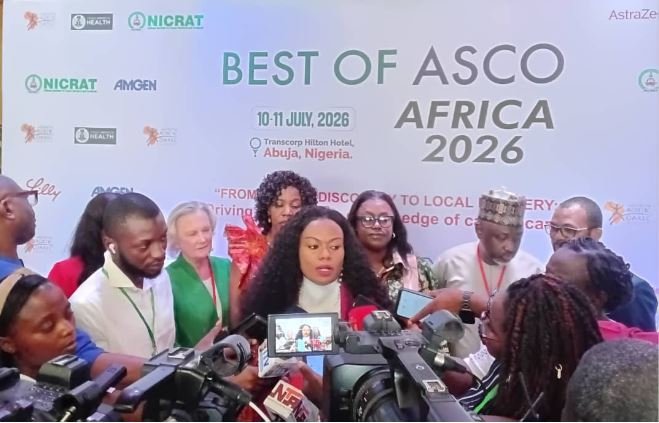
The conference with the theme, ” From Global Discovery to Local Delivery: Driving Africa to the Cutting Edge of Cancer Care”, focused on translating practice-changing global cancer research, advanced therapies and innovations for low resource and African clinical settings.
Best of ASCO Africa conference 2026 which took place in Abuja from July 10-11, 2026, brought the latest, most clinically impactful abstracts from the 2026 ASCO Annual Meeting to African Oncologists, fostering a collaborative environment to discuss practice, gaps and potential solutions for accessing innovative therapies, technologies, and resources.
Gathered in collaboration with the African Organization for Research in Cancer, together with the American Society of Clinical Oncology, and the National Institute for Cancer Research and Treatment, the experts deliberated on ways to domesticate and carry out the Best of ASCO Africa program in Africa with the aim to transmit the scientific findings presented in America down to Africa to enable medical practitioners learn and domesticate the research findings and implement the scientific findings in fighting
the scourge of cancer in Africa.
Speaking on the efficacy and availability of cancer treatments, a Chief Medical Officer at the ASCO, Julie Gralow, highlighted their research efforts, what they have done so far.
“What we’re doing here is presenting some of that research but putting it into the context of the African Continent. Many of these trials that will change practice immediately in the United States had no, or minimal participation from the African Continent.
These are drugs that have not been tested in people of African heritage, we don’t know if they’ll have the same response, the same side effects in that population, so that’s part of the discussion as to how do we treat cancer, how can we translate, implement strategies to get these drugs available to everyone,
everywhere not just those who have private insurance, how do we get them incorporated into the public Health Insurance Schemes throughout the world, and we have many who can’t access this kind of therapy in the US.
“We can learn from what is being done in Africa as to how to translate this back into a context that’s simpler and less expensive, more acceptable to patients, and that’s why we have this partnership back in 2020”, she said.
On his part, the Director General, National Institute for Cancer Research and Treatment, NICRAT, Professor Usman Aliyu, said the occasion aims to transmit the findings that were projected by scientists out there into the
Nigerian context.
He said NICRAT is an agency for cancer control under the Federal Ministry of Health with the mandate of leading in cancer prevention and control in the country, aw well as coordinating all cancer activities within the country right from cancer prevention, early detection,
diagnosis, treatment up to palliative care.
Professor Aliyu highlighted the significant progress made in strengthening Nigeria’s cancer research ecosystem, noting that the Institute had trained about 140 early-career Researchers through its Strengthening Institutional Capacity in Cancer Research, SINCA programme, and awarded research grants to 24 Scientists.
He announced the completion of the first phase of Nigeria’s Cancer Genome Study, describing it as a landmark achievement that would support precision medicine specifically tailored to the genetic characteristics of cancers affecting Nigerians.
He added that eight cancer centres had been upgraded nationwide, with three already equipped with modern linear accelerators and advanced diagnostic facilities, while procurement for additional centres is ongoing.
Also, a Medical Oncologist at the University of Illinois, Chicago, Abiola Ibrahim, said, Africa is intervening in bridging the gap between global cancer innovations and African patients by bringing the latest scientific findings directly to the Continent.
She said that although precision medicine, immunotherapy and targeted therapies are revolutionising cancer treatment globally, many African countries remain unable to access them due to their high costs. She emphasised that African countries will enjoy stronger negotiating power if they collectively engaged pharmaceutical companies for affordable access to innovative medicines.
“What Best of ASCO Africa does is bring the knowledge to the continent. People who cannot travel to the United States to attend ASCO can access the latest research here in Africa.
One country cannot do this alone. One institution cannot do this alone. We need each other for us to move forward.
“This is the reason why we have this initiative for us to talk about the new innovative technologies and therapies, and start thinking about how do we close the divide, how do we bring it to our Continent. One of the the goals of this conference or this initiative is to start thinking about how do we assess this as a pan-african initiative, bringing the whole African countries together, our economies together, because there’s power in number and the goal is that, if we will get to a point whereby all the countries are able to assess therapies, we have to do that as a Continent”, she said.
Meanwhile, a Breast Surgical Oncologist, and Immediate Past President, AORTIC, Miriam Mittobi, called for increased investments in prevention, early diagnosis, health financing and stronger health systems across Africa.
She stated that many African patients seek treatment only after reaching advanced stages of cancers, and are often unable to complete treatment because of financial hardship and weak healthcare systems.
“We do know that for many parts of Africa, patients are not only diagnosed with advanced disease, but they often do not complete their care,” she said.
She urged governments to strengthen screening programmes, improve the capacity of primary healthcare workers to detect cancer early and tackle the stigma that prevents many patients from seeking prompt medical attention.
She added that cancer response in Africa should build on lessons learnt from the Continent’s fight against infectious diseases by developing more integrated and patient-centred healthcare systems.
Meanwhile, the Special Adviser on Research and Innovation, office of the Minister of Health, Abuja, Dr. Lola Adeyemi, said One of the things that National Health Insurance is trying to do is to support cancer patients, noting that the Cancer Health Fund is a form of insurance that would to be covering some patients.
“There’s also the Social Determinants of Health Fund. Clinical trials is a significant part of the treatment ecosystem. One of the achievements
and accomplishments of Nigeria this year is that we have three immunotherapy studies in the country for the first time ever”, she said.
She added that with the provision people needing cancer care would not have to travel abroad to get the life-saving drugs.
The Minister of State for Health and Social Welfare, Dr. Iziaq Salako, said to ensure effective implementation, a multi-sectoral National Technical Working Group comprising cancer survivors, Clinicians, Researchers, Administrators, development partners, Civil Society Organisations and private sector representatives had been inaugurated.
He stressed that while Africa should continue to benefit from global scientific discoveries, Researchers on the Continent must generate evidence that reflects African realities.
The experts therefore called for stronger continental collaboration, increased investment in research, improved access to innovative treatments and locally-driven scientific evidence to reverse the alarming trend.
The conference brought together Oncologists, Researchers, Clinicians, policymakers, development partners from across Africa including the African Medical Center of Excellence in partnership with King’s College Hospital, London, Project PINK BLUE, to review the latest practice-changing findings presented at the 2026 American Society of Clinical Oncology.