
Nigeria-UAE Economic Relations Deepen as Non-Oil Trade Reaches $5 Billion.
By Owolola Adebola
Nigeria and the United Arab Emirates (UAE) have taken another significant step toward strengthening their bilateral relations, with non-oil trade between both nations reaching an impressive $5 billion in 2025.
The development signals a growing economic partnership anchored on trade, investment, aviation, diplomacy, and people-to-people engagement.
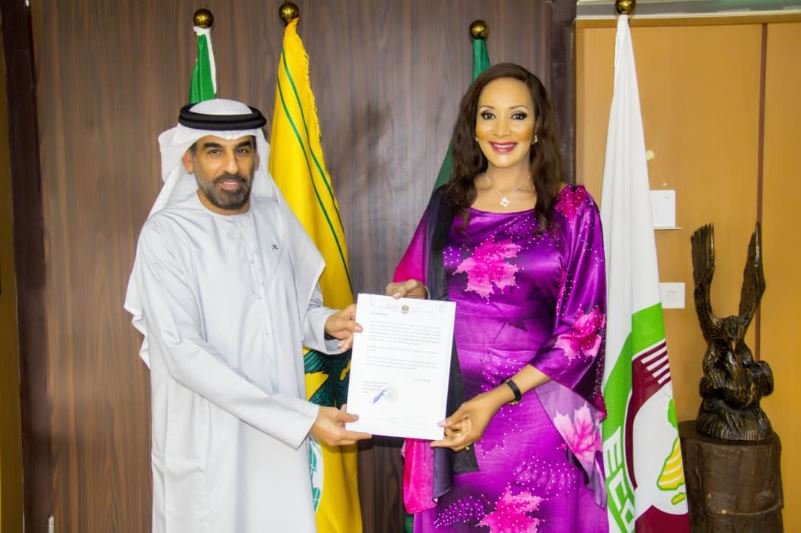
The announcement came during a diplomatic meeting between Nigeria’s Minister of Foreign Affairs, Ambassador Bianca Odumegwu-Ojukwu, and the UAE Ambassador to Nigeria, Salem Saeed Al-Shamsi, in Abuja. The meeting highlighted the remarkable progress made in the relationship between both countries and reaffirmed their commitment to expanding cooperation in strategic sectors.
One of the major highlights of the engagement was the disclosure that the First Abu Dhabi Bank (FAB), one of the UAE’s leading financial institutions, is set to commence operations in Lagos. The move is expected to strengthen financial connectivity between the two countries while opening new opportunities for trade financing, investment flows, and economic collaboration.
In another boost to bilateral ties, Etihad Airways, the UAE’s national carrier, is scheduled to begin operations in Abuja later this year. The commencement of direct operations to Nigeria’s capital city is expected to improve business travel, tourism, and commercial exchanges between both nations.
Nigeria and the UAE have maintained cordial diplomatic relations since 1971, with both countries increasingly leveraging economic diplomacy to deepen cooperation. Over the years, the relationship has evolved into a robust partnership driven largely by non-oil trade, investment partnerships, and growing human interactions.
Speaking during the meeting, Ambassador Al-Shamsi praised the positive trajectory of economic relations between the two nations. According to him, non-oil trade rose from $4.3 billion in 2024 to $5 billion in 2025, reflecting increasing commercial confidence and strategic engagement. He projected that trade volume could reach approximately $8 billion by 2027 if the current momentum is sustained.
The UAE envoy also announced that visa restrictions affecting Nigerian travelers had been significantly relaxed. According to him, Nigerian nationals are no longer experiencing widespread visa rejections, a development that has already encouraged increased travel between both countries. He revealed that over 15,000 Nigerians visited the UAE within the last year following the easing of travel restrictions.
Beyond economic matters, Ambassador Al-Shamsi reiterated the UAE’s solidarity with Nigeria in its ongoing fight against terrorism. He noted that the UAE government had consistently condemned terrorist attacks in Nigeria and had issued at least eight official statements expressing support for the country’s security efforts.
The diplomatic meeting also served as an opportunity for the UAE Ambassador to present a congratulatory letter from the UAE Deputy Prime Minister and Minister of Foreign Affairs, His Highness Sheikh Abdullah bin Zayed Al Nahyan, to Ambassador Odumegwu-Ojukwu on her appointment as Nigeria’s Minister of Foreign Affairs.
In her remarks, Ambassador Odumegwu-Ojukwu reaffirmed Nigeria’s commitment to creating an enabling environment for foreign direct investment, particularly from UAE-based sovereign wealth funds and private investors. She expressed satisfaction with the rapid resolution of several bilateral concerns, especially issues relating to visas and trade facilitation.
The Minister acknowledged the significant improvement in relations within a relatively short period, emphasising that sustained dialogue and diplomatic engagement had produced measurable results. She also commended the UAE leadership for its goodwill toward Nigeria and appreciated the support extended to her upon assumption of office.
According to her, the progress recorded in trade and diplomatic relations demonstrates the commitment of both countries to building a mutually beneficial partnership capable of delivering economic growth and prosperity for their citizens.
The implementation of the Comprehensive Economic Partnership Agreement (CEPA), recently signed by both nations, is expected to further consolidate this relationship. Analysts believe the agreement could unlock new opportunities for Nigerian businesses, professionals, exporters, and investors seeking access to the UAE market and broader global trade networks.
As Nigeria continues its economic diversification agenda beyond crude oil dependence, the strengthening partnership with the UAE represents a strategic model of modern economic diplomacy. With expanding trade volumes, increased air connectivity, improved visa policies, and growing investor confidence, both countries appear poised to usher in a new era of economic cooperation and shared prosperity.


