
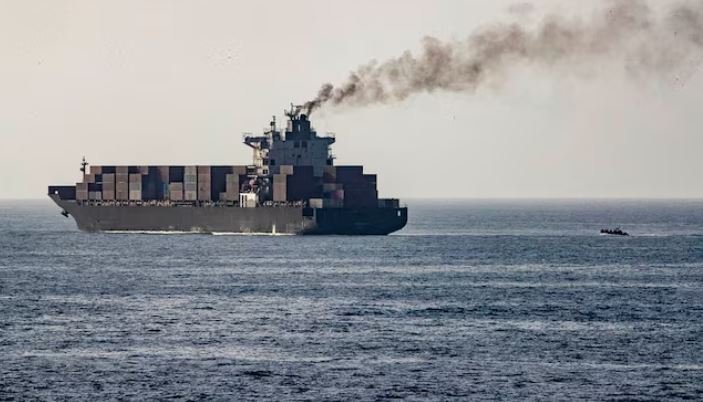
Legal Analysis of the US Seizure of the Iranian Cargo Ship, Touska.
By Owolola Adebola
In mid-April 2026, tensions between the United States and Iran escalated dramatically when the US Navy seized the Iranian-flagged cargo ship Touska in the Gulf of Oman near the Strait of Hormuz. The USS Spruance, a guided-missile destroyer, fired on the vessel’s engine room and dispatched Marines to board the ship after it allegedly refused to comply with repeated US warnings.
Iran’s Foreign Ministry condemned the action as “piracy” and “state terrorism,” while US officials justified it as an enforcement action within the framework of a naval blockade. This incident raises complex questions about international maritime law, the legality of blockades, and the extent to which military powers can unilaterally enforce sanctions at sea. The answer to whether this seizure is legal or illegal is neither straightforward nor binary—it depends heavily on the legal framework one examines and the underlying circumstances of the blockade itself.
The Legal Argument for Legality
The US government’s primary legal justification for the seizure rests on domestic US law and international maritime law provisions that permit enforcement actions against sanctioned vessels. The container ship Touska was flying the Iranian flag, but its owners have been under sanctions issued by the US Department of the Treasury and the US Office of Foreign Assets Control and have been accused of helping Iran evade sanctions. Under US law, particularly the International Emergency Economic Powers Act (IEEPA) and related statutes, the government has broad authority to regulate commerce and impose sanctions during national emergencies.
US law allows its Coast Guard to conduct searches and seizures on the high seas if the purpose is to enforce US laws. It states that the US Coast Guard “may make inquiries, examinations, inspections, searches, seizures, and arrests upon the high seas” to prevent violations. This provision, codified in Title 14 of the US Code, provides a statutory foundation for maritime enforcement actions.
International Maritime Law and Blockade Authority
The United Nations Convention on the Law of the Sea (UNCLOS), to which the US is not formally a party but largely observes, recognizes certain circumstances under which states may exercise control over vessels on the high seas and in territorial waters. During a state of armed conflict or under a blockade sanctioned by UN Security Council resolution, states have claimed enforcement authority over maritime traffic. The US imposed its blockade on Iranian ports on April 13, 2026, purportedly as part of ongoing military operations in response to Iran’s own restrictions on the Strait of Hormuz.
In the US government’s framework, the U.S. Navy “gave them fair warning to stop.
The Iranian crew refused to listen, so our Navy ship stopped them right in their tracks by blowing a hole in the engineroom,” according to Trump. CENTCOM said in a statement that the Iranian ship refused to comply with U.S. warnings over the course of six hours before the U.S. fired on the ship and boarded it, and that “American forces acted in a deliberate, professional, and proportional manner to ensure compliance.” This emphasis on proportionality and prior warning is intended to satisfy standards of necessity and restraint in international law.
It would be sane and safe to infer that,the US had previously employed similar tactics to enforce sanctions. In previous enforcement actions against sanctioned ships, the US has seized not only the ship itself but also the oil on board. In 2020, it confiscated fuel from four tankers allegedly carrying Iranian oil to Venezuela. These prior actions, while controversial, established a pattern of enforcement that the US argues is consistent with international norms regarding sanctions implementation.
Of course, Iran’s characterization of the seizure as “piracy” invokes the most fundamental law of the sea. According to the United Nations Convention on the Law of the Sea (UNCLOS), acts of piracy are “any illegal acts of violence or detention, or any act of depredation, committed for private ends by the crew or the passengers of a private ship or a private aircraft”. While this technical definition may not fit—since the US is acting in a governmental capacity—the underlying concern about the use of military force to seize a merchant vessel in international waters remains serious.
A maritime law expert noted the tension between legal authority and actual practice, observing that if the US keeps flexing its maritime muscle at the edges of conventional legal frameworks, “the only thing missing is an eye patch and a parrot.” This criticism, though somewhat satirical, highlights a genuine concern: whether unilateral seizures of merchant vessels, regardless of their owners’ sanctions status, conform to established international law.
The seizure occurred within the context of a unilateral US blockade of Iranian ports. Iran’s government disputes the legitimacy of this blockade, viewing it as a violation of the ceasefire agreement then in effect. A true naval blockade in international law is typically understood as an action taken during formally declared war or with specific authorization from the UN Security Council. The US blockade in this instance was imposed unilaterally by executive decision without congressional declaration of war and without UN Security Council authorization, raising questions about its legal standing.
It is worthy of mentioning that, Iran has accused the U.S. of violating the ceasefire by keeping a blockade on Iranian ports in place, and cited what it described as “Washington’s excessive demands, unrealistic expectations, constant shifts in stance, repeated contradictions, and the ongoing naval blockade,” which Iran considers a breach of the ceasefire. Under the ceasefire agreement’s terms, the continuation of the blockade may itself constitute an illegal action, making enforcement of that blockade doubly problematic.
UNCLOS Constraints on the Exercise of Authority
While UNCLOS does grant coastal states certain rights in their territorial waters and economic exclusive zones, the waters where the Touska was seized—the Gulf of Oman and approaches to the Strait of Hormuz—involve more ambiguous jurisdictional questions. Article 87 of UNCLOS guarantees high seas freedoms, including freedom of navigation, to all nations. A cargo ship exercising this freedom cannot be summarily fired upon and seized without clear legal justification that rises to the level of actual piracy, legitimate enforcement of a formally recognized blockade, or response to an imminent threat—none of which are clearly established in this case.
The reality is that, this seizure exists in a gray zone of international law. Several complicating factors prevent a definitive legal judgment:
State Practice vs. Legal Principle: The international legal system lacks a central enforcer, and powerful states have long used military means to enforce their perceived interests. This creates a gap between what states routinely do and what international law formally permits. The US seizure reflects this familiar tension.
The Nature of the Blockade: The legality of the seizure is inextricably linked to the legality of the blockade itself. If the blockade is illegal or violates a ceasefire, then enforcement of that blockade through seizure is also problematic. If the blockade is legal, the seizure becomes more defensible. Yet the blockade’s legal status remains contested.
Sanctions Regime Enforcement: The invocation of OFAC sanctions raises questions about extraterritorial application of US law. While UNCLOS and customary international law do permit some enforcement of sanctions on the high seas, the scope and limits of this authority remain contested among international lawyers.
Proportionality of Force: Even assuming the US had authority to direct the ship to stop, the use of force—firing on the vessel’s engine room—raises questions about whether the response was proportional to the resistance encountered. International law requires that enforcement actions use only the minimum force necessary to achieve compliance,
In summary,the legality of the US seizure of the Iranian cargo ship Touska cannot be answered with a simple “legal” or “illegal” determination. From the US perspective, the action falls within established legal authorities granted to enforce sanctions and conduct maritime enforcement operations. The emphasis on proportionality, prior warning, and the sanctions history of the vessel’s owners provides some legal foundation for the action.
Be that as it may, from an international law perspective rooted in UNCLOS and customary maritime law, the seizure is problematic. It represents a unilateral exercise of military power against a merchant vessel in waters where jurisdictional authority is ambiguous, undertaken as part of an enforcement action in support of a blockade whose own legality is disputed and potentially violates an existing ceasefire agreement.
The most accurate assessment is that the US seizure occupies a legally contested space—defensible under certain interpretations of domestic US law and sanctions enforcement authority, but questionable under broader principles of international maritime law that protect merchant shipping and constrain the unilateral use of force at sea.
This ambiguity reflects a deeper tension in international law: the absence of unanimous agreement on what constitutes legitimate enforcement authority when powerful nations take unilateral action. In such situations, legality becomes less a matter of clear legal rules and more a matter of competing interpretations, state practice, and the political willingness of the international community to challenge or accept such actions.
What is clear is that this seizure represents an escalation in US-Iran maritime tensions and demonstrates the fragile state of both the ceasefire and the international legal order governing the freedom of the seas