
When Drums Speak And History Answers: Reclaiming the Soul of Africa Through the Gbaraun–Egbesu Festival.
By: Amb. Dr. Samson Joseph Iriruaga
There are moments in history when a, people must pause—not to mourn what was lost, but to rediscover what still lives. The annual festival of Gbaraun–Egbesu Ibolomobo-Ere & Amaseikumor in the ancient Gbaramatu Kingdom is one such moment. It is not merely a cultural gathering; it is a living archive, a sacred theatre where spirituality, identity, and heritage converge in rhythmic harmony.
To witness this festival is to encounter Africa—not the Africa described in foreign texts, but the Africa that breathes through its people, speaks through its drums, and reveals itself in symbols older than colonial memory.

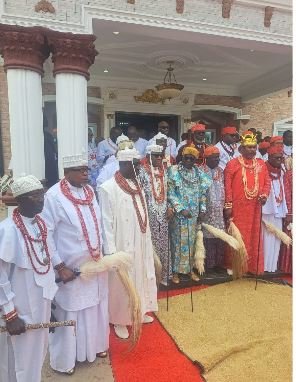
Led by the revered monarch, His Royal Majesty, Oboro Gbaraun II, JP, Aketekpe Agadagba, Pere of the ancient Gbaramatu Kingdom, strengthened by the influential ministration
of High Chief Government Ekpemupolo (Tompolo), the Ibe-Ebidouwei of Ijaw land, and graced by royal fathers from across the nation, the festival stands as a bold declaration: African spirituality is not primitive—it is profound.
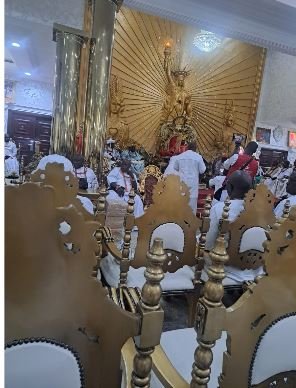
My own presence in the royal entourage of His Royal Majesty, Monday Obukowho Arthur Whiskey, Udurie I, King of the great Idjerhe Kingdom, adds not just prestige, but testimony. For there are things one can not be told—one must see, hear, and feel them.
A Festival That Speaks in Many Tongues
From the thunderous beats of traditional drums to the poetic grace of Gbaramatu cultural dances, the festival unfolds like a sacred manuscript. The wrestling contests echo ancient rites of strength and honour. The masquerades—particularly the awe-inspiring Amaseikumor—are not mere spectacles; they are embodiments of ancestral presence, spiritual intermediaries between the seen and, unseen.
Music flows—not as entertainment alone, but as invocation. The maestros of soulful expression do not just perform; they awaken memory.
Here, culture is not staged—it is lived.
African Native Religion: Before the Shadows Came
Long before the arrival of European missionaries and colonial administrators, Africa had systems—structured, functional, and deeply spiritual. African traditional religion was not a scattered belief; it was a cohesive worldview.
From the Nile Valley civilizations to the forests of West Africa, Africans understood:
●The oneness of the Supreme Being (known by various names across cultures)
●The role of ancestors as custodians of morality and continuity
●The balance between nature, humanity, and the divine
●The use of rituals, festivals, and symbols as tools of social order and spiritual alignment
Even classical historians like Herodotus documented aspects of African spirituality with a tone of respect, describing Egyptian (African) religious systems as among the most structured of the ancient world.
African religion was never chaotic—it was codified in oral traditions, proverbs, rites, and communal ethics.
The Missionary Encounter: Illumination or Erasure?
The arrival of missionaries brought literacy, yes—but also a subtle displacement of identity. Indigenous belief systems were labeled “pagan,” sacred groves were desecrated, and ancestral practices were dismissed as superstition.
One must ask, not in hostility but in honesty: Was the mission purely, spiritual, or partially cultural conquest?
The British colonial experience in Nigeria, for instance, did not only introduce Christianity and Western education—it redefined legitimacy. What was African became inferior; what was Western became aspirational.
The result? A gradual psychological shift.
The Tragedy of Cultural Amnesia
Today, many Africans proudly recite foreign histories yet stumble when asked about their own lineage. Western names replace indigenous ones. Traditional attire is reserved for ceremonies, while foreign fashion dominates daily life. Native languages fade in urban spaces.
This is not evolution—it is erosion.
Scholars like Chinua Achebe warned of this in works like Things Fall Apart, where the disintegration of Igbo society under colonial pressure symbolized a broader African experience. Similarly, Ngũgĩ wa Thiong’o argued passionately for the decolonization of the African mind, insisting that language and culture are inseparable from identity.
Westernization and the Fragmented African Identity
In the present age, globalization has accelerated what colonialism began. Western ideals dominate media, education, governance, and even spirituality.
African children grow up celebrating foreign holidays more than indigenous festivals.
Local belief systems are practiced in secrecy, while imported religions are practiced in pride.
Cultural symbols are commercialized abroad while being neglected at home.
This is not a call to reject the West—it is a call to restore balance.
For a tree that forgets its roots cannot withstand the storm.
The Gbaraun Festival as Resistance and Revival
Against this backdrop, the Gbaraun–Egbesu festival stands as an act of cultural resistance.
It reminds Africans that:
●Their heritage is not inferior—it is foundational
●Their spirituality is not outdated—it is enduring
●Their identity is not lost—it is recoverable
It challenges the African elite, the educated, and the globalized to return—not in regression, but in reconnection.
A Gentle Rebuke to the African Mind
It is both ironic and painful that many Africans need validation from Western institutions before appreciating their own heritage. We export our culture, only to re-import it as “art,” “tourism,” or “anthropology.”
Why must Africa be explained to Africans?
Why must the drum be translated before it is heard?
A Call to Witness, Not Just Hear
“When last did you attend an African festival?”
This question is not rhetorical—it is revolutionary.
For to, attend is to remember.
To remember is to reclaim.
And to reclaim is to restore dignity.
Conclusion:
The Future Rooted in the Past
Culture is not outrageous—it is original.
Humanity is cultural—there is no civilization without it.
The Gbaraun–Egbesu festival is more than fun (though it is richly so); it is education, restoration, and declaration. It tells the world—and reminds Africa—that the gods are indeed wise, the traditions purposeful, and the people deeply rooted.
My journey with the royal entourage was not just a privilege—it was a pilgrimage.
May more Africans make that journey—not just to Gbaramatu, but back to themselves.
For in rediscovering our culture, we do not reject the world—we finally understand our place within it.